Home > News & Research > VIDEO – Vestibular Evoked Myogenic Potentials (cVEMPs) – 6 Pediatric PEARLS
VIDEO – Vestibular Evoked Myogenic Potentials (cVEMPs) – 6 Pediatric PEARLS
Published on: November 5, 2013
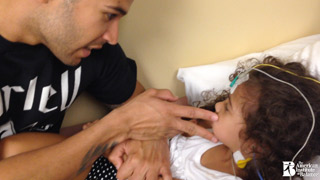
At AIB we perform and obtain reliable Vestibular Evoked Myogenic Potentials (C-VEMPs) on infants and children quite easily. Here are several videos, which illustrate some techniques. It may vary from the infant laying on the parent’s lap, or resting comfortably, to collection during a righting reflex. The modifications we use are based on infants-child’s age. The sternocloidomastoid muscle (SCM) must be activated, during testing, as the cVEMP is an “off” EMG response.
PEARLS
1.) It is helpful to fully palpate the muscle prior to electrode placement, which will ensure a solid placement on the belly of the muscle.
2.) No need to scrub- just get the electrode to stick on clean-dry skin, this is a huge EMG response.
3.) Focus more on lateral flexion, which is the primary function of the SCM, rather than trying for a full rotation. This is also true for adults.
4.) This lateral flexion can be accomplished by playing with the child and watching for the physical state of the flexed SCM prior to starting data collection.
5.) Relax- unlike BAER, we want the child to be active-awake and there is no issue of background noise. Play and have fun.
6.) Remember, a conductive loss affects VEMP so always know middle ear status prior to interpretation of an absent response.
Recent Posts
Building Blocks of a Balance Business
Published on: October 31, 2025
Audiology Today | November/December 2024 The profession of audiology has changed in so many ways over the past two decades due to both internal and external forces. These include improved […]
Read more
Case Study: Vestibular Migraine or Postural Orthostatic Tachycardia Syndrome?
Published on:
HearingReview.com | September/October 2025 Symptoms of dizziness, lightheadedness, and headaches are common symptoms in both vestibular migraine (VM) and postural orthostatic tachycardia syndrome (POTS). Both conditions are often underdiagnosed but […]
Read more
The Efficacy of the Gans Repositioning Maneuver in Comparison with the Epley Maneuver in Elderly Patients with Benign Paroxysmal Positional Vertigo
Published on: June 30, 2025
Published on: 4 March 2025 Auditory and Vestibular Research, Spring 2025;34(2):144-150 Benign Paroxysmal Positional Vertigo (BPPV) impacts the quality of life of affected people, especially the elderly. The Epley maneuver […]
Read more
Seasonal incidence of benign paroxysmal positional vertigo
Published on: February 6, 2025
Journal of Otolaryngology – ENT Research | Volume 16 – Issue 1 – 2025 Benign paroxysmal positional vertigo (BPPV) is the most frequent type of peripheral vestibular vertigo.1 BPPV is […]
Read more