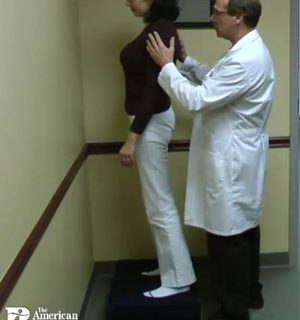
VIDEO – CTSIB Sensitivity Improved with Head Shake
Published on: January 14, 2014
First described by Shumway-Cook and Horak in 1986, the Clinical Test of Sensory Integration of Balance ( CTSIB ) has withstood the test of time as one of the most sensitive and cost-effective low technology assessment tools for a non-compensated vestibular condition. This author has utilized the protocol in testing over 100,000 patients and it is incorporated into the Gans Sensory Organization Performance Test (conditions 5 and 6). In direct side-to side comparison with CDP, it clearly is as sensitive in identifying those patients who “lose” ankle strategy secondary to vestibular dysfunction.
At AIB we are interested in development of protocols, which easily and cost-effectively reveal functional impairments, which are not readily obvious through VNG, VEMP or rotary chair testing. We have found in hundreds of patients, during the past 6 years, that the addition of controlled horizontal headshake (approximately at 1-2 cps) during CTSIB (eyes closed/foam) has excellent sensitivity in revealing a yet uncompensated unilateral vestibular dysfunction (UVD). This identification of uncompensated status serves as both an excellent assessment tool, but more importantly, provides direction as to the need for additional and specific vestibular rehabilitation requirements.
Case Study: 42 year-old female post vestibular neuritis and post 5 weeks of VRT (at another facility) states she is “much better than she was” but is at 70% recovered, and feels she is still “off” during higher level activities i.e. playing tennis, golf, head turn while driving and looking quickly when changing lanes. VNG, VEMP and rotary Chair are all unremarkable.
As can be seen in the video, her CTSIB (eyes closed/Foam) is normal, but when the CTSIB is performed with the horizontal headshake (eyes closed/foam) she uses a stepping strategy and “falls” indicating an uncompensated deficit. A new more rigorous course of VRT was implemented, reflecting the context specificity of the frequency and direction of head movement, which was still uncompensated. Within 2 weeks of engaging in the new therapeutic VRT protocols she asymptomatic when engaging high level activities.
Take Home Message: Compensation is context specific and occurs across a wide frequency range. VRT protocols must reflect the appropriate activity level, complexity and needs of the individual patient.
References:
- Shumway-Cook, A. and Horak, FB. Assessing the influence of sensory integration of balance, suggestions from the field. Phys. Ther. 1986;66(10) 1548-50
- Gans, R. Vestibular Rehabilitation Therapy, In Dispenza F. and DeStefano, A., Textbook of Vertigo Diagnosis and Management, Jaypee Brothers Medical Publishers, London, 2013