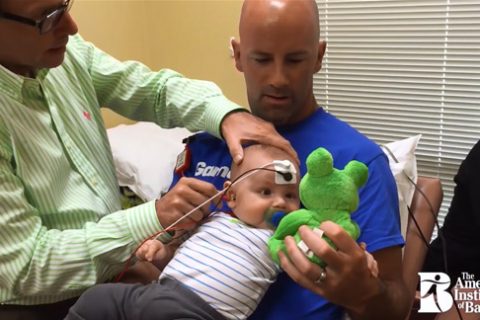
VIDEO CASE STUDY: cVEMP- Best Test for Infants
Published on: July 22, 2015
By age 3-4 months, infant’s neck musculature is typically strong enough to provide sufficient support to allow for reliable use of cervical Vestibular Myogenic Potentials, (cVEMP). A question may be asked, why test a baby? The literature clearly shows the co-morbidities of sensorineural hearing loss (SNHL) and vestibular abnormalities. Therefore, it is our opinion and protocol at AIB, that all infants with identified SNHL should be screened with cVEMP. Their motor milestone development should also be closely monitored to reveal any significant delays e.g. age of head control, sitting independently, crawling, etc. It is also important to remember that of the 500 known syndromes and mitochondrial disorders, most have greater prevalence of vestibular than auditory expressivity. Any infant with delayed motor milestones should be considered at risk and at least screened with cVEMP.
In this video, you will see one of the easiest techniques used with a 4-month old infant. Our experience is that the cVEMP is quickly, reliably and easily obtained in infants. Unlike BAER, the infant is best tested, active-awake and engaged, as we need the sternocleidomastoid muscle (SCM) contracted, as the cVEMP is an “off” EMG response. We typically use protocols which include parent participation but also as can be seen in the second segment playful movement of the child to engage the SCM.

References:
1. Gans, R.E., Evaluation and Management of Vestibular Function in Infants and Children with Hearing Loss, In Madell, J.R. and Flexer, C., (2014) Pediatric Audiology Diagnosis, Technology and Management, Thieme Medical Publishers, Inc. New York.
.2 Picciotti PM, Fiorita A, DiNardo W, Calò L, Scarano E, Paludetti G. (2007) Vestibular evoked myogenic potentials in children. Int J Pediatr Otorhinolaryngol 71:29–33.
3. Sheykholesami K, Kaga K, Megerian, CA. Arnold JE. (2005) Vestibular-evoked myogenic potentials in infancy and early childhood. Laryngoscope 115:1440–1444.
4. Zhou G, Kenna MA, Stevens K, Licameli G. (2009) Assessment of saccular function in children with sensorineural hearing loss. Otolaryngol Head Neck Surg 135(1):40–44.