Migraine Awareness – Caloric Eye Speed
Published on: June 4, 2019
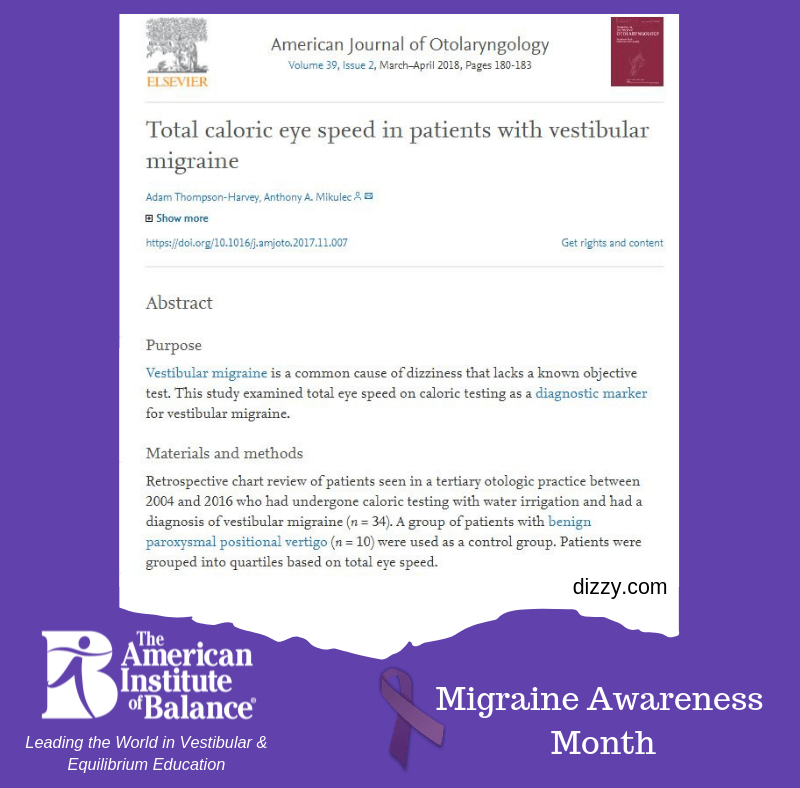 Thompson-Harvey and Mikulec (American Journal of Otolaryngology 39, 180–183 (2018)) investigated the utility of using caloric eye speed to inform the diagnosis of vestibular migraine (VM). Comparisons between from 34 vestibular migraineurs and 10 patients with benign paroxysmal positional vertigo (BPPV) revealed that only the lowest caloric eye speeds were correlated to VM. The measure is not a valid way to distinguish VM from other vestibular disorders.
Recent Posts
Building Blocks of a Balance Business
Published on: October 31, 2025
Audiology Today | November/December 2024 The profession of audiology has changed in so many ways over the past two decades due to both internal and external forces. These include improved […]
Read more
Case Study: Vestibular Migraine or Postural Orthostatic Tachycardia Syndrome?
Published on:
HearingReview.com | September/October 2025 Symptoms of dizziness, lightheadedness, and headaches are common symptoms in both vestibular migraine (VM) and postural orthostatic tachycardia syndrome (POTS). Both conditions are often underdiagnosed but […]
Read more
The Efficacy of the Gans Repositioning Maneuver in Comparison with the Epley Maneuver in Elderly Patients with Benign Paroxysmal Positional Vertigo
Published on: June 30, 2025
Published on: 4 March 2025 Auditory and Vestibular Research, Spring 2025;34(2):144-150 Benign Paroxysmal Positional Vertigo (BPPV) impacts the quality of life of affected people, especially the elderly. The Epley maneuver […]
Read more
Seasonal incidence of benign paroxysmal positional vertigo
Published on: February 6, 2025
Journal of Otolaryngology – ENT Research | Volume 16 – Issue 1 – 2025 Benign paroxysmal positional vertigo (BPPV) is the most frequent type of peripheral vestibular vertigo.1 BPPV is […]
Read more