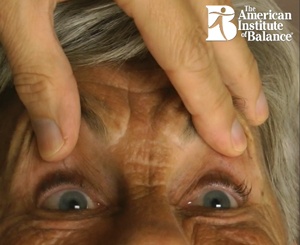
VIDEO – PC-BPPV Nystagmus: It’s not so rotary after all
Published on: September 6, 2013
In this video we see a strong and clear nystagmus consistent with a right ear (PC-BPPV Nystagmus: It’s not so rotary after all) PC-BPPV. The nystagmus, while described as “rotary-torsional”, will actually have a more visible upward and oblique movement than may be anticipated by new practitioners.
Often times, practitioners new to BPPV are perplexed when they begin see their first PC-BPPV patients after learning in their lectures about “rotary-torsional” nystagmus. It is important to remember Ewald’s 1st Law. Simply put, vertical canal BPPV produces vertical nystagmus. Posterior canal is upbeat, anterior canal (rare) downbeat, both with an oblique “twist” toward the ground. Also worth considering is the varying viscoelastic properties of the extra-ocular muscles. The rectus muscles are larger and stronger and the obliques, smaller and weaker. This often causes an earlier fatigue of the “rotary” aspect of the nystagmus but leaving the vertical component, which is rectus, dominated.
For a comprehensive discussion of eye movement, corresponding muscles and canal involvement see Roberts and Gans, Chapter 9, In Jacobson and Shephard (Eds.), Balance Function Assessment and Management, Plural, 2008.
Recent Posts
Building Blocks of a Balance Business
Published on: October 31, 2025
Audiology Today | November/December 2024 The profession of audiology has changed in so many ways over the past two decades due to both internal and external forces. These include improved […]
Read more
Case Study: Vestibular Migraine or Postural Orthostatic Tachycardia Syndrome?
Published on:
HearingReview.com | September/October 2025 Symptoms of dizziness, lightheadedness, and headaches are common symptoms in both vestibular migraine (VM) and postural orthostatic tachycardia syndrome (POTS). Both conditions are often underdiagnosed but […]
Read more
The Efficacy of the Gans Repositioning Maneuver in Comparison with the Epley Maneuver in Elderly Patients with Benign Paroxysmal Positional Vertigo
Published on: June 30, 2025
Published on: 4 March 2025 Auditory and Vestibular Research, Spring 2025;34(2):144-150 Benign Paroxysmal Positional Vertigo (BPPV) impacts the quality of life of affected people, especially the elderly. The Epley maneuver […]
Read more
Seasonal incidence of benign paroxysmal positional vertigo
Published on: February 6, 2025
Journal of Otolaryngology – ENT Research | Volume 16 – Issue 1 – 2025 Benign paroxysmal positional vertigo (BPPV) is the most frequent type of peripheral vestibular vertigo.1 BPPV is […]
Read more