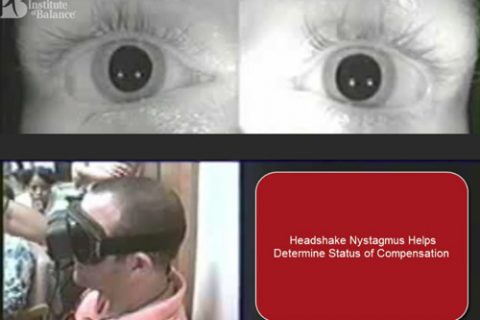
VIDEO: Headshake Nystagmus Helps Determine Status of Compensation
Published on: July 17, 2013
The introduction of a headshake protocol within a bedside examination or VNG is often useful in revealing an active or yet uncompensated vestibulopathy within the frequency of the VOR. The protocol is performed with the patient seated, however its sensitivity will be enhanced when performed in a lateral body position. The caveat is that the patient must be in a vision-denied condition to ensure absence of a visual suppression effect, requiring VOG or VNG video-goggle. Frenzels will not provide this, as the patient can easily see the insides of the goggle.
As can be seen in this video case study, the post head shake nystagmus beats away (slow phase) from the impaired end-organ with the fast phase towards the intact labyrinth (Ewald’s 2nd Law). This is the most common pattern, but a recovery nystagmus may show a reversal of this pattern. Numerous investigators have reported a sensitivity of as high as 95%, but with somewhat poor specificity (49%).
The presence of the nystagmus is a clear indication that the patient is an uncompensated state and an ideal candidate for Vestibular Rehabilitation. This may be further correlated with other function tests such as CTSIB, Dynamic Visual Acuity, etc.
Recent Posts
Building Blocks of a Balance Business
Published on: October 31, 2025
Audiology Today | November/December 2024 The profession of audiology has changed in so many ways over the past two decades due to both internal and external forces. These include improved […]
Read more
Case Study: Vestibular Migraine or Postural Orthostatic Tachycardia Syndrome?
Published on:
HearingReview.com | September/October 2025 Symptoms of dizziness, lightheadedness, and headaches are common symptoms in both vestibular migraine (VM) and postural orthostatic tachycardia syndrome (POTS). Both conditions are often underdiagnosed but […]
Read more
The Efficacy of the Gans Repositioning Maneuver in Comparison with the Epley Maneuver in Elderly Patients with Benign Paroxysmal Positional Vertigo
Published on: June 30, 2025
Published on: 4 March 2025 Auditory and Vestibular Research, Spring 2025;34(2):144-150 Benign Paroxysmal Positional Vertigo (BPPV) impacts the quality of life of affected people, especially the elderly. The Epley maneuver […]
Read more
Seasonal incidence of benign paroxysmal positional vertigo
Published on: February 6, 2025
Journal of Otolaryngology – ENT Research | Volume 16 – Issue 1 – 2025 Benign paroxysmal positional vertigo (BPPV) is the most frequent type of peripheral vestibular vertigo.1 BPPV is […]
Read more